The Planes that Never Came Back
The spiritual reconstruction project is doing the bullet hole analysis — studying the traditions that survived. But the traditions that didn't survive aren't damaged planes. They never came back. And some of them are still being shot down.
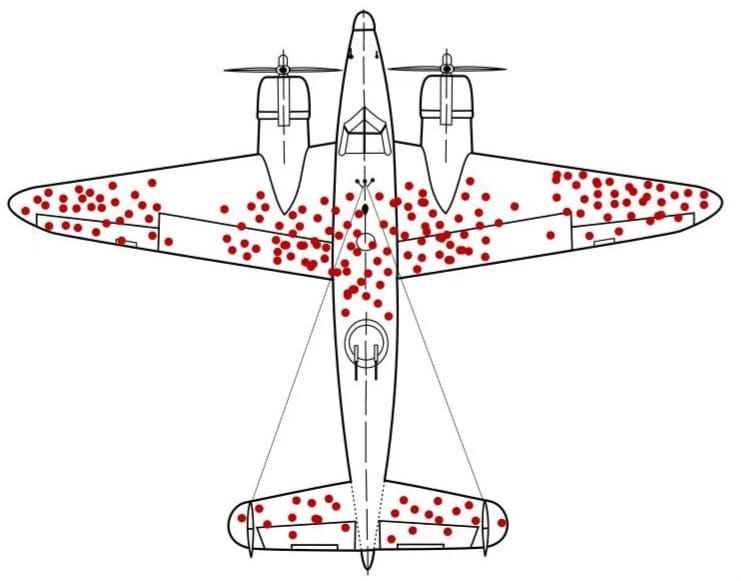
Military analysts in World War II were reviewing aircraft returning from combat missions, mapping where they'd taken fire. Bullet holes clustered across the fuselage, the wings, the tail. The instinct was to reinforce those areas — that's where the damage was showing up, that's where the work needed to happen.
Then someone pointed out what was wrong with the analysis.
The planes they were looking at were the ones that came back. The damage they were mapping was damage that hadn't brought the planes down. The areas where surviving planes hadn't been hit — those were where the planes that never returned had been hit. The data from those missions wasn't in the record because the planes carrying it never made it home.
There is a project happening right now in the spiritual world that I find genuinely moving and genuinely important. Across podcasts and lineages and communities, serious people are looking at what remains of our wisdom traditions — the practices and stories and frameworks that survived — and trying to understand what they have in common. Trying to find the thread back to something more alive than what industrial capitalism left us with. The Emerald podcast is one of the most serious examples of this I've encountered. What Josh Schrei is doing — drawing on animist and mythological frameworks, finding commonalities across surviving traditions, taking seriously the question of what human beings have always known that we've collectively forgotten — that work matters. It has shaped how I see the world. I am grateful for it. And it is, structurally, the bullet hole analysis. It is looking at the planes that came back. Mapping where they were hit. Trying to understand what made them durable enough to survive. This is real and valuable work. But it cannot tell you about the missions that never returned. It cannot recover what went down with those planes. And the reconstruction project, however serious and beautifully done, is working from an incomplete record — and the conversations happening within it are largely among those who live where the bullet holes are, without much genuine exchange with the communities that keep not making it back.
The traditions that survived did so in part because they had properties that let them make it through everything that went wrong. They could be written down. They could be practiced individually without requiring collective containers. They were legible enough to the dominant structures that they weren't completely destroyed. Some made explicit compromises to remain. Some found ways to hide in plain sight.
And crucially — they were legible as spiritual rather than merely cultural. That distinction, between the spiritual and the cultural, is one our ancestors would not have recognised. It did not exist in the way we now take for granted. The separation of spiritual practice from the rest of lived culture — from the way people moved, made things, gathered, grieved, celebrated, embodied different energies in community — is itself one of the things that went wrong. It was a sorting mechanism, and it sorted with extraordinary consistency. What got classified as spiritual was preserved, studied, transmitted. What got classified as merely cultural was dismissed, suppressed, or simply not seen as carrying anything worth preserving.
The traditions that didn't survive left almost nothing. Not damaged remnants — nothing. No texts, because the transmission was always embodied, always collective, always requiring community to hold. No lineage holders, because the lineage holders were the primary targets. No practices, because the practices required conditions that were systematically dismantled. Many of them would not have understood themselves as spiritual traditions in the first place — because that category didn't exist for them. They were simply how people lived, how they moved, who they were in community together.
These weren't damaged planes. They were the ones that never returned.
I am a trans woman. I come from an embodiment lineage with at least two hundred years of documented practice within the English-speaking world (A Short History of Trans Misogyny, Jules Gill-Peterson, Verso 2024) — a lineage that developed not in ashrams or lineage halls, but in the margins, in the spaces the dominant culture decided were not fit for respectable people.
I am not alone in this. Across cultures and across history, gender-variant people have held recognised and important cultural roles. The Two-Spirit traditions across hundreds of Indigenous North American nations. The māhū of Hawaii, whose role was specifically as educators and conservators of ancient knowledge. The fa'afafine of Polynesia, the hijra traditions of South Asia, the kathoey traditions of Thailand. These weren't peripheral figures. They were often the ones holding some of the most essential knowledge their communities had.
Whatever force it is that consolidates power and decides who belongs — wearing many masks, many faces, many kinds of authority — that force has consistently identified people like us as a threat and responded accordingly. Colonisation is one of its most systematic forms. That consistency is not accidental. It tells you something about what was being carried.
The people who looked like me were sent to hell. Not metaphorically — condemned by the religious institutions of the dominant culture, named as threats to the social order, systematically destroyed. The traditions we carried went down with us. For a very long time — in some places for over a thousand years. Some of those traditions have been rebuilt, painstakingly, in the margins. Some are still being shot down.
I'll cite sources here in a way the rest of this piece doesn't, because I've learned that when I say this without them, people don't believe me.
In January 2026, genocide scholars — including two former presidents of the International Association of Genocide Scholars and the founder of Genocide Watch — published warnings that the United States is in the early stages of a genocidal process targeting trans, nonbinary, and intersex people. By March 2026, the Lemkin Institute issued its third Red Flag Alert, stating that the US is "squarely within the early to middle stages of a genocidal process against trans people, the goal of which is to completely erase transgender people not only from public life but also from existence." The Trans Genocide Watch is tracking it in real time.
The planes are still going down. This is not history. This is now.
The spiritual world — the serious parts of it, the parts doing genuine reconstruction work — is, in the main, troubled by this. There is concern. There is solidarity of a kind.
What there isn't, mostly, is recognition.
Recognition that what is being destroyed is not only a vulnerable population in need of protection. That it is, among other things, one of the deepest re-emergent embodiment traditions in the Western world. That the communities being targeted — trans, queer, neurodivergent, the various people who have been living at the margins of what gets called normal — have been doing serious work for decades out of sheer necessity. Not in lineage halls, but in apartments and clubs and community centres and festival spaces. And not calling it spiritual, because the divide that separated spiritual from cultural is part of what made them targets in the first place.
When I look around me, I see practices coming back. Not through study — through being. I see trans men and trans women and non-binary people developing embodied ways of moving through the world that are genuinely new and genuinely ancient at the same time. I see voguing and the traditions of the ballroom, which have their own elaborate language for how masculine and feminine energies move through a body. I see neurodivergent people whose minds work in ways so diverse it is genuinely phenomenal to witness — the Buddhists say the nature of mind is infinite, and I believe them, because I see it. I see friends who are finding their way back to mythology not by reading about it but by embodying it — vampires, fairies, creatures, plants, animals, energies that don't have names in the surviving traditions because the surviving traditions never got that far.
This is the re-emergence. It is happening. And most of us are hiding while it happens, because the shooting hasn't actually stopped.
Not because anyone is pulling the trigger with intention. But because the reflexes are still there, carried in the bodies of communities that have, at the level of stated values, genuinely stopped wanting us in hell. The person who scurries away when I sit down in the closing circle of an ecstatic dance. The tantric space that cannot register my practice as embodiment. The careful holding-at-arm's-length when I raise something difficult. The bubble of polite distance that forms around me in spaces that have decided they are welcoming.
The communities gathered around this reconstruction work are, in the main, troubled by this. There is concern. There is solidarity of a kind.
What there isn't, mostly, is recognition.
Recognition that what is being destroyed is not only a vulnerable population in need of protection. That it is, among other things, one of the deepest re-emergent embodiment traditions in the Western world. That the communities being targeted — trans, queer, neurodivergent, the various people who have been living at the margins of what gets called normal — have been doing serious work for decades out of sheer necessity. Not in lineage halls, but in apartments and clubs and community centres and festival spaces. And not calling it spiritual, because the divide that separated spiritual from cultural is part of what made them targets in the first place.
When I look around me, I see practices coming back. Not through study — through being. I see trans men and trans women and non-binary people developing embodied ways of moving through the world that are genuinely new and genuinely ancient at the same time. I see voguing and the traditions of the ballroom, which have their own elaborate language for how masculine and feminine energies move through a body. I see neurodivergent people whose minds work in ways so diverse it is genuinely phenomenal to witness — the Buddhists say the nature of mind is infinite, and I believe them, because I see it. I see friends who are finding their way back to mythology not by reading about it but by embodying it — vampires, fairies, creatures, plants, animals, energies that don't have names in the surviving traditions because the surviving traditions never got that far.
This is the re-emergence. It is happening. And most of us are hiding while it happens, because the shooting hasn't actually stopped.
Not because anyone is pulling the trigger with intention. But because the reflexes are still there, carried in the bodies of communities that have, at the level of stated values, genuinely stopped wanting us in hell. The person who scurries away when I sit down in the closing circle of an ecstatic dance. The tantric space that cannot register my practice as embodiment. The careful holding-at-arm's-length when I raise something difficult. The bubble of polite distance that forms around me in spaces that have decided they are welcoming.
This is why we call it transphobia. Not trans-hate — though there is hate too. Trans-phobia. Fear. The phobia is still alive in the nervous system of cultures that consciously want to do better. It lives in reflex rather than intention. And those reflexes sound like bullets to us. They look like bullets. And they keep us away.
I found the Emerald a few years ago. I heard people who clearly, genuinely, did not want to be shooting at people like me. And so I decided to try to make my way toward them. To step across. Everyone I have met along the way has been genuinely kind. And every one of them carries these reflexes — I can feel them, even when nobody in the room is naming them. Even when they are trying their hardest. There is a reckoning available in all of this. It looks like ancestral healing, shadow work, the work of turning toward what a lineage did and staying with what you see. Cultural lineage travels differently than spiritual lineage — leaving one tradition for another doesn't necessarily release someone from the world they came from. My communities are doing this work around our own histories. It doesn't feel like spiritual practice to those whose sense of the spiritual runs only toward the light. For those who understand that genuine practice requires moving through the dark as well, it is exactly that. And what I've come to understand is that this particular healing — the one between these two worlds — isn't something either side can complete alone. It only becomes available in the contact between us. The work of reconstruction is real. The planes that came back matter. Their wounds deserve attention. But I am standing here, having made the journey across at significant cost, carrying things that the reconstruction project needs and does not have. And I cannot bring them into the conversation — not because I am unwilling, but because of a closed loop that the reflexes enforce without anyone choosing it. Authority in the spiritual world is conferred by recognised depth of practice within recognised traditions. My tradition is not recognised, so I carry no authority. But without authority, I have no standing to ask for my tradition to be recognised. The loop closes before the words can land. If that loop doesn't get broken, my community won't feel safe enough to cross over. The knowledge stays on one side. And the planes keep not coming back. I made it back. Maybe now we can look at this together.